What does good fan engagement actually look like on a club website?
Aug 16, 2026 · 4 min
Fan Engagement
"Fan engagement" is one of the most overused phrases in football. Here's a practical definition: how many clicks does it take a supporter to do the thing they came to do?
Ask ten clubs how their fan engagement is going and you'll get ten answers about social media. Impressions, reach, follower growth, a good week on TikTok. All useful numbers, but they measure attention, not engagement - and attention on someone else's platform at that.
The more honest test happens on your own website, in the hours before kick-off, when a supporter arrives with a specific job in mind. They want to know what time it starts. They want to read something about the opposition. They want the programme. They want to put a scoreline in for the predictor before the deadline.
Good engagement is what happens when all of that is easy. Bad engagement is a supporter opening four tabs, hitting a PDF that won't scroll on a phone, and giving up.
The last 24 hours are the ones that count
Every barrier costs you supporters, and the closer you get to kick-off, the more expensive each one becomes. A fan browsing on a Tuesday evening will tolerate a bit of digging. A fan checking their phone on Friday night, or on the way to the ground on Saturday, will not.
That final day is when the website earns its keep. It's your highest-traffic window, your best chance to put commercial partners in front of an engaged audience, and the moment when a matchday programme either gets read or doesn't. If the route to any of it involves more than a tap or two, the content may as well not exist.
So the design question isn't "what else can we add?" It's "what can a supporter get to in one tap from the fixture?"
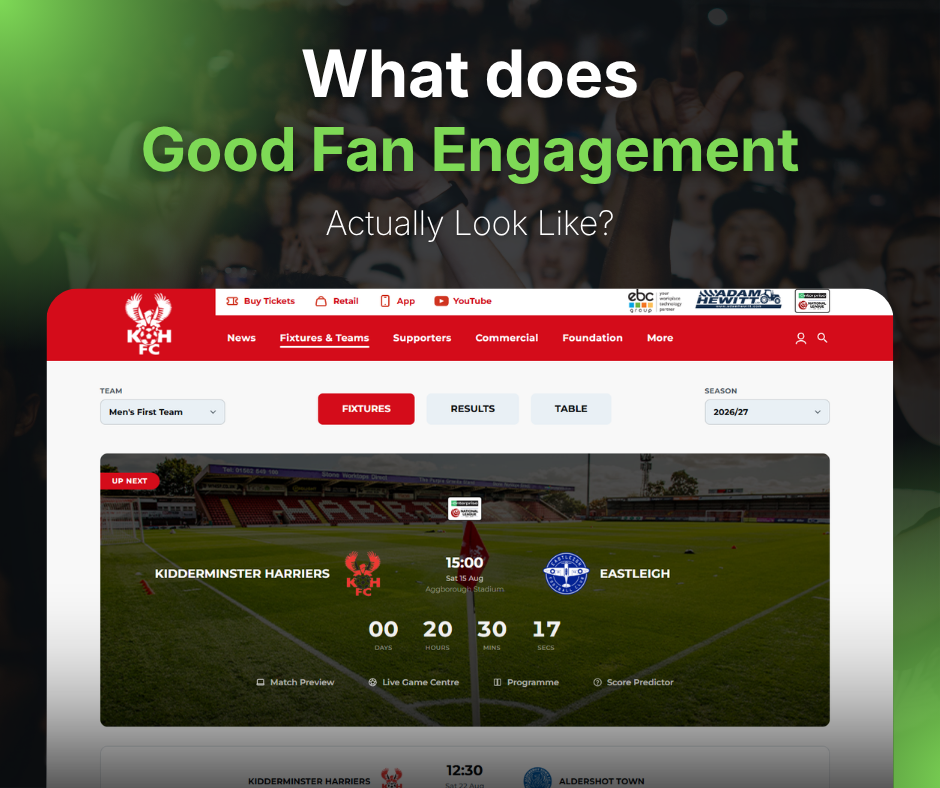
A worked example: the new Kidderminster Harriers matchday page
The new Kidderminster Harriers website, developed in collaboration with StandBased, is built around exactly that idea. With less than 24 hours to kick-off, everything a Harriers fan needs sits on a single page.
The basics, done properly. Kick-off time, venue, competition, both teams. It sounds too obvious to mention, and it's the thing most often got wrong - buried under a hero image, split across two pages, or missing the one detail that actually matters, like whether it's a home game. Get this right and you've solved the majority of pre-match visits before anyone scrolls.
Live Game Centre. One hub for the match itself: live text updates, line-ups as they drop, stats, goalscorers. Not a link to a third-party scores site, not a Twitter thread - a place on your own site where a supporter who can't be at the ground follows along, and a supporter who is there checks the line-up without leaving your ecosystem.
Match preview. The long-form piece: team news, form, the story of the fixture, what's at stake. This is the content that rewards the fans who care most, and it belongs one tap from the fixture rather than three clicks deep in a news archive.
Score Predictor. Free to play, prizes attached, and the single most reliable way to turn a passive reader into a returning one. A supporter who submits a prediction has a reason to come back at full time, and a reason to come back next week. Because it runs on the same Harriers Account as the club app, they don't sign up again - they're already logged in.
The digital matchday programme. Programmes have gone digital across the game, and too often that has meant a PDF nobody opens on a phone. Making The Harrier genuinely easy to reach - properly readable on mobile, right there next to the fixture - is what keeps a century of matchday tradition alive rather than quietly killing it.
The principle underneath
None of these features is individually revolutionary. What makes the difference is that they sit together, on one page, behind one account, with no dead ends between them.
That's the part clubs tend to miss when digital provision is assembled supplier by supplier. The website comes from one place, the app from another, the programme from a third, the predictor from a competition platform bolted on for the season. Each piece works. None of them know about each other. And the supporter pays for that fragmentation in clicks, logins and abandoned intentions.
Build it as one system and every addition compounds. The predictor drives return visits. The account carries a fan between app and site. The programme gets read because it's where people already are. Sponsors get seen because the traffic is concentrated rather than scattered.
That's what fan engagement actually looks like. Not a reach figure - a supporter who found what they wanted, first time.
The countdown to matchday is ON. Come on you Harriers!